How to Read the Map
Physics can seem like a pile of separate subjects: mechanics, optics, thermodynamics, nuclear physics, astrophysics. This map shows the pile has a shape. Down the side runs size, from the inside of a proton to the cosmic web, a span of more than forty powers of ten. Across the top run six questions that can be asked of anything at any size: how it moves, what pushes on it, where its energy goes, how it is built, how it changes, and how disturbances travel through it.
Every cell where a row meets a column holds representative phenomena, not an exhaustive list. Read across a row to see one world from every angle; read down a column to watch one idea, such as waves, reappear at every scale in new clothing.
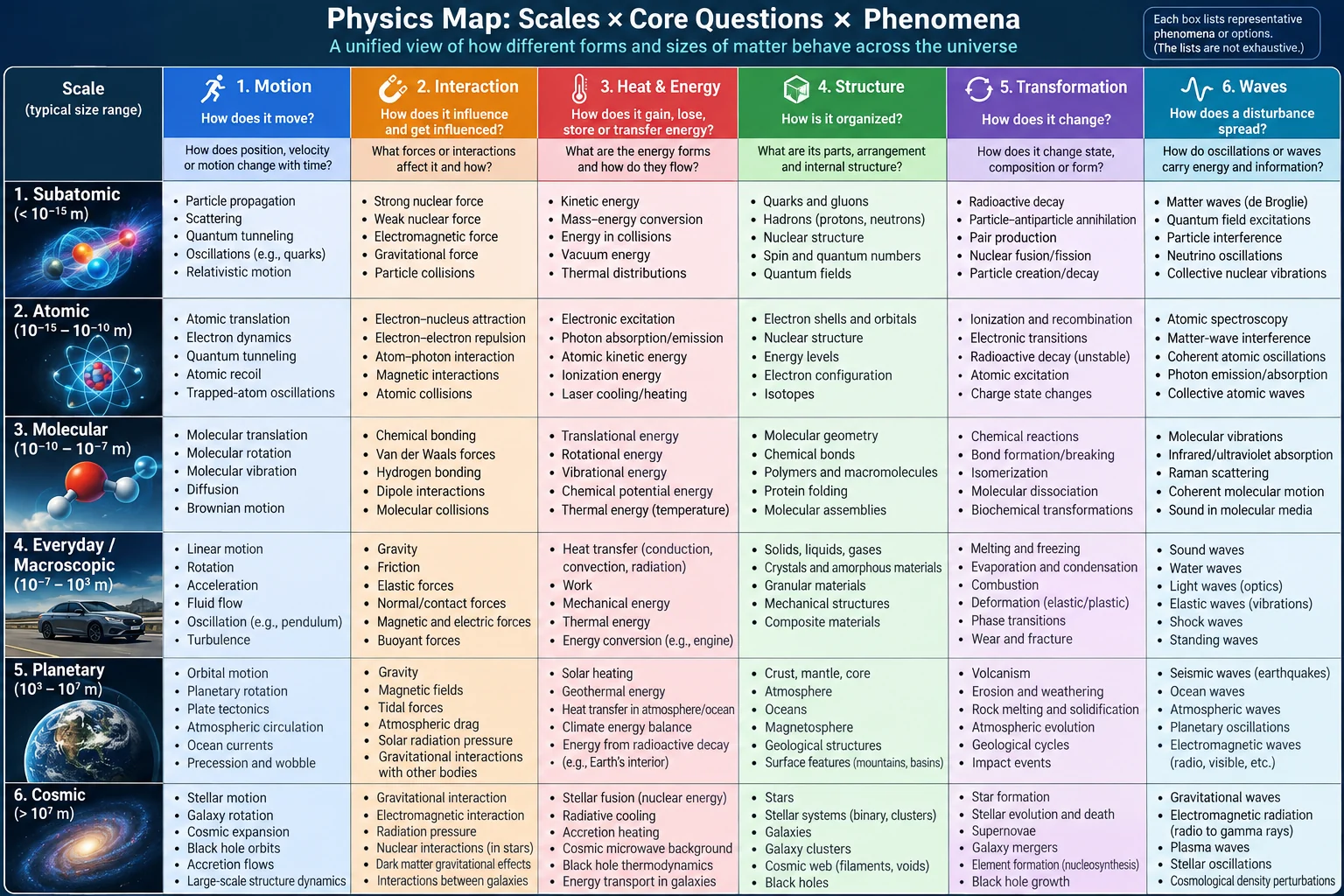
1.1 The six scales
Sizes are given in metres as powers of ten: 10⁻¹⁰ m is a ten-billionth of a metre, about the width of an atom. The boundaries are approximate; nature does not draw lines, and neighbouring scales overlap.
1. Subatomic
< 10⁻¹⁵ m
The world inside the atom's nucleus, where the strong and weak nuclear forces rule and quantum effects are everything.
Typical objects Quarks, protons, neutrons, nuclei
2. Atomic
10⁻¹⁵ – 10⁻¹⁰ m
A nucleus wrapped in a cloud of electrons. Electromagnetism takes over, and light and matter trade energy in fixed packets.
Typical objects Atoms, ions, electrons in orbitals
3. Molecular
10⁻¹⁰ – 10⁻⁷ m
Atoms bonded into molecules. This is the realm of chemistry and biochemistry, where shape decides function.
Typical objects Water, DNA, proteins, viruses
4. Everyday / Macroscopic
10⁻⁷ – 10³ m
Things we can see and touch. Classical mechanics and thermodynamics work beautifully here.
Typical objects Cells, people, cars, buildings
5. Planetary
10³ – 10⁸ m
Whole worlds: their interiors, oceans, air and orbits. Gravity, rotation and internal heat shape everything.
Typical objects Mountains, Earth, Jupiter
6. Cosmic
> 10⁸ m
Stars, galaxies and the universe itself. Gravity dominates and light from far away is also light from long ago.
Typical objects Stars, galaxies, the cosmic web
1.2 The six questions
Each question has a colour that follows it through the map.
1. Motion
How does it move?
How do position, velocity or motion change with time?
2. Interaction
How does it influence and get influenced?
What forces or interactions affect it, and how?
3. Heat & Energy
How does it gain, lose, store or transfer energy?
What forms does energy take, and how does it flow?
4. Structure
How is it organised?
What are its parts, their arrangement and internal structure?
5. Transformation
How does it change?
How does it change state, composition or form?
6. Waves
How does a disturbance spread?
How do oscillations or waves carry energy and information?
Explore the Map
Search any word, such as tunnelling, gravity, or Nobel, or narrow the map by scale and question. Filters combine: choosing Atomic and Waves shows only that cell, while choosing two scales shows both. Open an item to read what it means and see an example. Items marked ✎ carry an editor's note where the original chart has been corrected or clarified.
ScaleSubatomic < 10⁻¹⁵ m
Particle propagation
How a particle travels from one place to another. In quantum physics a moving particle is described as a spreading wave packet rather than a tiny ball on a fixed track, and fast particles must be treated with relativity.
Example Muons produced by cosmic rays high in the atmosphere race down to the ground, where detectors count about one per square centimetre per minute.
Scattering
When one particle is deflected by another. Watching how particles bounce off a target is physicists' main way of 'seeing' structure far too small for any microscope.
Example Rutherford's gold-foil experiments (1909–1911) found that a few alpha particles bounced almost straight back, revealing that atoms have a tiny, dense nucleus.
Quantum tunnelling
A particle can pass through an energy barrier it classically lacks the energy to climb, because its wave spreads a little way into and beyond the barrier.
Example Alpha decay: George Gamow showed in 1928 that an alpha particle escapes a uranium nucleus by tunnelling out, which explains why half-lives vary so enormously.
Bound motion of quarks✎
Quarks are never still: they move restlessly inside protons and neutrons, held in by the strong force. Most of a proton's mass comes from this motion and binding energy, not from the quarks' own tiny masses.
Example The three 'valence' quarks of a proton account for only about 1% of its mass; the rest is energy of moving quarks and gluons (E = mc²).
Editor's note The source chart says 'Oscillations (e.g., quarks)'. Quarks don't oscillate in a simple sense; the accurate idea is confined motion inside hadrons. (Particle 'oscillation' proper — neutrinos — is listed under Waves.)
Relativistic motion
At speeds close to light speed, time slows for the moving particle (time dilation), lengths contract, and energy and momentum grow without limit as speed approaches c.
Example A muon lives about 2.2 microseconds at rest — too short to cross the atmosphere — yet it reaches the ground because its clock runs slow from our point of view.
Strong nuclear force
The strongest of the four fundamental forces. Carried by gluons, it glues quarks into protons and neutrons, and its leftover 'residual' pull binds protons and neutrons into nuclei. It acts only over about 10⁻¹⁵ m.
Example A helium nucleus holds two positively charged protons a femtometre apart; without the strong force their electric repulsion would blow it apart instantly.
Weak nuclear force
The force that can change one type of quark into another, turning a neutron into a proton or vice versa. Its carriers, the W and Z bosons, were discovered at CERN in 1983.
Example The first step of fusion in the Sun turns a proton into a neutron through the weak force — which is why the Sun burns slowly enough to last billions of years.
Electromagnetic force
The force between electric charges, carried by photons. Inside the nucleus it acts against binding, because protons repel each other.
Example As nuclei grow larger, proton repulsion builds up; this is why no stable element exists beyond lead (element 82).
Gravitational force✎
Gravity acts on every particle, but at this scale it is almost nothing: between two protons, the electric push is about 10³⁶ times stronger than the gravitational pull.
Example Particle physics experiments can ignore gravity entirely — yet uniting gravity with quantum theory remains one of physics' great unsolved problems.
Editor's note Listed in the source chart as a subatomic interaction. It does act, but is negligible here — this note keeps it in proportion.
Particle collisions
Smashing particles together at high energy, either in accelerators or naturally (cosmic rays). The collision energy can turn into brand-new particles.
Example The Large Hadron Collider's proton collisions revealed the Higgs boson in 2012.
Kinetic energy
Energy of motion. Particle physicists measure it in electron-volts (eV): the energy one electron gains crossing one volt.
Example Each proton in the LHC carries about 6.8 trillion eV — roughly the kinetic energy of a flying mosquito, packed into a single particle.
Mass–energy conversion
Einstein's E = mc²: mass is a form of energy and the two can convert. Because c² is huge, a small mass corresponds to an enormous energy.
Example When hydrogen fuses into helium, about 0.7% of the mass disappears as energy; that missing mass powers the Sun.
Energy in collisions
In a high-energy collision the energy budget is shared between motion and the creation of new particles. More energy means heavier particles can be made.
Example To make a Higgs boson (about 125 GeV of mass-energy), colliding particles must deliver at least that much energy in one event.
Vacuum energy
Quantum theory says even 'empty' space has a minimum, non-zero energy, with fields constantly fluctuating. How this relates to the dark energy driving cosmic expansion is an open question.
Example Naive calculations of vacuum energy overshoot the observed dark energy by around 120 powers of ten — the 'cosmological constant problem'.
Thermal distributions
In a hot collection of particles, energy is spread statistically: most particles are near average, a few are much faster. At extreme temperatures, protons and neutrons 'melt'.
Example Heavy-ion colliders such as RHIC and the LHC briefly create quark–gluon plasma at trillions of degrees, recreating the universe's first microseconds.
Quarks and gluons
Quarks come in six 'flavours' (up, down, charm, strange, top, bottom); gluons carry the strong force between them. Neither is ever seen alone — they are permanently confined.
Example A proton is two up quarks and one down quark (uud); a neutron is udd.
Hadrons (protons, neutrons)
Composite particles made of quarks. Baryons (like protons) contain three quarks; mesons contain a quark and an antiquark.
Example The proton's charge radius is about 0.84 femtometres (0.84 × 10⁻¹⁵ m), a value settled after a decade-long 'proton radius puzzle'.
Nuclear structure
Protons and neutrons inside a nucleus fill energy shells, much as electrons do in atoms. Nuclei with full shells ('magic numbers' 2, 8, 20, 28, 50, 82, 126) are especially stable.
Example Lead-208 has 82 protons and 126 neutrons — 'doubly magic' — and is the heaviest stable nucleus.
Spin and quantum numbers
Particles carry built-in labels — charge, spin, and others — that never take in-between values. Spin is a built-in angular momentum; particles with half-integer spin (fermions) cannot share a state.
Example MRI scanners work by flipping the spins of hydrogen nuclei (protons) in the body with radio waves.
Quantum fields
The modern picture: every type of particle is a ripple in a field that fills all of space. Particles are the smallest possible excitations of those fields.
Example The Higgs field gives elementary particles their mass; the Higgs boson is its ripple.
Radioactive decay
An unstable nucleus spontaneously emits radiation (alpha, beta, or gamma) and becomes more stable. Each isotope decays at a fixed statistical rate, its half-life.
Example Carbon-14 has a half-life of about 5,730 years, which lets archaeologists date organic remains.
Particle–antiparticle annihilation
When a particle meets its antiparticle, both vanish and their mass becomes energy, usually photons.
Example PET scans detect pairs of 511 keV photons from positrons annihilating with electrons in the body.
Pair production
The reverse of annihilation: an energetic photon passing near a nucleus turns into a particle and its antiparticle. The photon needs at least 1.022 MeV to make an electron–positron pair.
Example High-energy gamma rays striking lead shielding are stopped partly by turning into electron–positron pairs.
Nuclear fusion / fission
Fusion joins light nuclei; fission splits heavy ones. Both release energy because the products are more tightly bound than the starting nuclei.
Example A single uranium-235 fission releases about 200 MeV — tens of millions of times more than a typical chemical reaction per atom.
Particle creation / decay
Most particles are unstable and decay into lighter ones, conserving energy, charge and other quantities. New particles can be created whenever enough energy is available.
Example A free neutron, outside a nucleus, decays into a proton, an electron and an antineutrino in about 15 minutes on average.
Matter waves (de Broglie)
In 1924 Louis de Broglie proposed that every particle has a wavelength: the larger its momentum, the shorter the wave.
Example Davisson and Germer (1927) saw electrons diffract off a nickel crystal exactly like X-rays — proof that electrons behave as waves.
Quantum field excitations
A particle is a wave-like excitation of its quantum field, carrying a definite amount (quantum) of energy.
Example A photon is a single quantum of the electromagnetic field.
Particle interference
Single particles sent one at a time through two slits build up an interference pattern, as if each passed through both slits as a wave.
Example Electron double-slit experiments, done one electron at a time, slowly form bright and dark fringes on the screen.
Neutrino oscillations
Neutrinos switch between their three types (electron, muon, tau) as they travel. This can only happen if neutrinos have mass.
Example It solved the 'solar neutrino problem' and earned Takaaki Kajita and Arthur McDonald the 2015 Nobel Prize.
Collective nuclear vibrations
All the protons and neutrons in a nucleus can move together — the nucleus can ring, swell, or have its protons slosh against its neutrons.
Example The 'giant dipole resonance', in which protons swing against neutrons, strongly absorbs gamma rays of roughly 10–20 MeV.
ScaleAtomic 10⁻¹⁵ – 10⁻¹⁰ m
Atomic translation
Atoms moving through space as a whole. In a gas they fly freely between collisions; their average speed rises with temperature.
Example At room temperature, helium atoms average well over 1,000 m/s — faster than a rifle bullet.
Electron dynamics
Electrons don't circle the nucleus like planets; they occupy cloud-like orbitals. When disturbed, electron clouds rearrange in attoseconds (10⁻¹⁸ s).
Example The 2023 Nobel Prize in Physics (Agostini, Krausz, L'Huillier) honoured attosecond light pulses that can film electron motion.
Quantum tunnelling
Electrons can cross a tiny gap that classical physics says they cannot. The tunnelling rate is extremely sensitive to the gap's width.
Example The scanning tunnelling microscope (Binnig and Rohrer, Nobel 1986) images individual atoms by measuring this current.
Atomic recoil
An atom that emits or absorbs a photon gets a small kick, like a gun recoiling. Each kick is tiny, but many add up.
Example Laser cooling uses millions of these kicks, aimed against an atom's motion, to slow it down.
Trapped-atom oscillations
Atoms held by lasers or electric/magnetic fields sway back and forth in their traps, and their motion itself becomes quantised.
Example Trapped-ion quantum computers use these shared vibrations to link qubits together.
Electron–nucleus attraction
The negative electrons are pulled toward the positive nucleus by the electric (Coulomb) force. This is what holds an atom together.
Example It takes 13.6 eV to pull the electron out of a hydrogen atom.
Electron–electron repulsion
Electrons push each other away, and inner electrons 'screen' the nucleus from outer ones. This shapes the order in which orbitals fill.
Example Screening is why potassium's last electron goes into the 4s orbital rather than 3d.
Atom–photon interaction
Atoms absorb, emit and scatter light. Only photons whose energy matches a gap between energy levels are absorbed.
Example Sodium streetlamps glow a pure yellow-orange because sodium atoms emit at about 589 nm.
Magnetic interactions
Electrons behave like tiny magnets because of their spin and orbital motion. In an outside magnetic field, energy levels split (the Zeeman effect).
Example In 1908 George Ellery Hale used Zeeman splitting to discover strong magnetic fields in sunspots.
Atomic collisions
Atoms constantly bump into each other and into walls. These collisions transfer energy and momentum.
Example Gas pressure is simply the combined push of countless atomic collisions against a container's walls.
Electronic excitation
An electron is lifted to a higher energy level by absorbing energy — from light, heat or a collision. It soon drops back and releases it.
Example Neon signs glow when an electric current excites neon atoms, which then emit their characteristic red light.
Photon absorption / emission
Each element absorbs and emits light only at specific wavelengths — a fingerprint set by its energy levels.
Example Helium was discovered in the Sun's spectrum in 1868, decades before it was found on Earth.
Atomic kinetic energy
Temperature is a measure of the average kinetic energy of atoms. Hotter means faster atoms.
Example For an ideal gas, average kinetic energy per atom is (3/2)·k·T — doubling the absolute temperature doubles it.
Ionisation energy
The energy needed to remove an electron completely from an atom. It varies across the periodic table.
Example Noble gases such as helium (about 24.6 eV) hold their electrons most tightly, which is why they are so unreactive.
Laser cooling / heating
Carefully tuned lasers can remove kinetic energy from atoms (or add it), reaching temperatures a millionth of a degree above absolute zero.
Example Laser cooling earned the 1997 Nobel Prize and made the first Bose–Einstein condensate possible in 1995.
Electron shells and orbitals
Electrons fill shells at increasing distances from the nucleus; each shell has orbitals with distinctive shapes (s spherical, p dumbbell-shaped, d and f more complex).
Example Carbon's four outer electrons sit in 2s and 2p orbitals, which is why it forms four bonds.
Atomic nucleus✎
The tiny, dense centre of the atom — about 1/100,000 of its width — holding more than 99.9% of its mass.
Example If an atom were a football stadium, its nucleus would be a pea on the centre spot.
Editor's note The source chart lists 'Nuclear structure' in both the Subatomic and Atomic rows. Here it is reframed as the nucleus's place within the atom; its internal structure is in the Subatomic row.
Energy levels
Electrons in an atom can have only certain energies, like rungs on a ladder. Niels Bohr introduced this idea in 1913.
Example Hydrogen's visible spectral lines come from electrons falling to the second rung (the Balmer series).
Electron configuration
The arrangement of electrons in shells. The outermost (valence) electrons decide how an element behaves chemically.
Example Sodium (1s² 2s² 2p⁶ 3s¹) has one lonely outer electron, which it gives away easily — so it reacts violently with water.
Isotopes
Atoms of one element with different numbers of neutrons. They behave almost identically in chemistry but differ in mass and stability.
Example Carbon-12 and carbon-13 are stable; carbon-14 is radioactive.
Ionisation and recombination
Ionisation strips electrons from atoms; recombination is when ions capture them back, often emitting light.
Example About 380,000 years after the Big Bang, electrons and nuclei recombined into neutral atoms, releasing the light we now see as the cosmic microwave background.
Electronic transitions
Electrons jumping between energy levels. Each jump absorbs or emits a photon of exactly matching energy.
Example The second is defined by a transition in caesium-133 atoms: exactly 9,192,631,770 cycles of its radiation.
Radioactive decay (unstable nuclei)✎
A nuclear process that changes an atom's identity: when the number of protons changes, the atom becomes a different element.
Example Uranium in rocks decays through a chain that produces radon gas, which can build up in basements.
Editor's note Decay happens in the nucleus (see the Subatomic row); it appears here because its effect is a change of element.
Atomic excitation
Raising an atom to a higher-energy state through collisions or light, before it relaxes back.
Example Auroras' green glow comes from oxygen atoms excited by solar-wind particles, emitting at 557.7 nm.
Charge-state changes
Atoms gaining or losing electrons to become ions. This is the basis of ionic chemistry and of plasmas.
Example In table salt, sodium has given an electron to chlorine, forming Na⁺ and Cl⁻ ions.
Atomic spectroscopy
Reading the light atoms absorb or emit to identify them and measure their conditions.
Example Astronomers know the chemical makeup of stars billions of light-years away from the lines in their spectra.
Matter-wave interference
Whole atoms — and even large molecules — can act as waves and interfere, just like light.
Example Atom interferometers measure gravity so precisely they can detect underground density changes; in 1999 even C₆₀ 'buckyball' molecules showed interference.
Coherent atomic oscillations
Many atoms oscillating in step, like a choir singing exactly in tune. Coherence makes extraordinarily precise timekeeping possible.
Example Optical atomic clocks are so stable they would drift less than a second over the age of the universe.
Photon emission / absorption
Atoms emit light spontaneously, or are 'stimulated' to emit an identical photon by passing light — the principle Einstein described in 1917.
Example Theodore Maiman's ruby laser (1960) was the first to use stimulated emission to produce visible laser light.
Collective atomic waves
When atoms are ultracold and closely packed, they can move as one quantum object, carrying waves through the whole cloud.
Example Sound waves have been sent through Bose–Einstein condensates, which behave like a single giant 'super-atom'.
ScaleMolecular 10⁻¹⁰ – 10⁻⁷ m
Molecular translation
Whole molecules moving from place to place. In air they travel only about 70 nanometres on average before hitting another molecule.
Example Nitrogen molecules in room-temperature air move at roughly 500 m/s, yet a smell still takes seconds to cross a room because of constant collisions.
Molecular rotation
Molecules tumble and spin. Their rotational energies are quantised, so they absorb specific microwave frequencies.
Example Microwave ovens jostle water molecules, which constantly try to align their electric dipoles with the field; the friction of this jostling heats food. (It is not a narrow resonance, contrary to a common myth.)
Molecular vibration
Atoms in a molecule move back and forth as if joined by springs — stretching, bending and twisting their bonds.
Example Carbon dioxide's bending vibration absorbs infrared radiation from Earth's surface — the heart of the greenhouse effect.
Diffusion
The gradual, net spreading of molecules from where they are concentrated to where they are scarce, caused by random motion.
Example A drop of food colouring slowly spreads through still water without any stirring.
Brownian motion
The jittery dance of a small visible particle, kicked from all sides by invisible molecules.
Example Robert Brown saw it in pollen grains in 1827; Einstein explained it in 1905, and Jean Perrin's measurements (1908) convinced sceptics that atoms are real.
Chemical bonding
Atoms joining by sharing electrons (covalent), transferring them (ionic) or pooling them (metallic).
Example In a water molecule, oxygen shares electron pairs with two hydrogen atoms.
Van der Waals forces
Weak, short-range attractions between all molecules, caused by fleeting shifts in their electron clouds.
Example Geckos climb glass walls using millions of tiny foot hairs that cling by van der Waals forces.
Hydrogen bonding
A strong type of attraction between a hydrogen atom bonded to oxygen, nitrogen or fluorine and a neighbouring electronegative atom.
Example Hydrogen bonds hold DNA's two strands together and give water its unusually high boiling point.
Dipole interactions
Molecules with a lopsided charge (a positive end and a negative end) attract or repel each other depending on how they line up.
Example Water dissolves salt because its polar molecules surround and pull apart the charged ions.
Molecular collisions
Molecules colliding with enough energy and the right orientation can react. Rates rise sharply with temperature.
Example A rough rule of thumb: many reactions run about twice as fast for every 10 °C rise — why food keeps longer in the fridge.
Translational energy
The energy of molecules moving from place to place. In a gas it is what we sense as temperature.
Example Heating air in a closed tyre speeds up its molecules, raising the pressure.
Rotational energy
Energy stored in molecules' tumbling. Molecules with more ways to rotate can store more heat.
Example This is part of why a gas of two-atom molecules (like N₂) needs more heat to warm up than a single-atom gas (like helium).
Vibrational energy
Energy stored in the stretching and bending of bonds. Vibrations need larger energy jumps, so they 'switch on' only at higher temperatures.
Example The heat capacity of many gases climbs as temperature rises, because vibrations begin to soak up energy.
Chemical potential energy
Energy stored in the arrangement of atoms and bonds, released or absorbed when reactions rearrange them.
Example Fat stores about 9 kcal per gram versus about 4 for sugar, so it is the body's compact long-term fuel.
Thermal energy (temperature)
The total random-motion energy of molecules. Temperature measures its average; absolute zero (−273.15 °C) is where it reaches the quantum minimum.
Example A bathtub of warm water holds far more thermal energy than a red-hot spark, even though the spark is hotter.
Molecular geometry
The 3-D shape of a molecule, set by how electron pairs around each atom push each other apart.
Example Water is bent at about 104.5°, not straight — which makes it polar and gives it many of its life-sustaining properties.
Chemical bonds
The links between atoms, each with a typical length and strength. Double and triple bonds are shorter and stronger.
Example A carbon–carbon single bond is about 0.154 nanometres long.
Polymers and macromolecules
Giant molecules made by linking many small units (monomers) into long chains or networks.
Example DNA, proteins, cellulose, nylon and polyethylene are all polymers.
Protein folding
A chain of amino acids folding into a precise 3-D shape that determines what the protein does. Misfolding can cause disease.
Example AlphaFold predicts protein structures from sequence; its creators Demis Hassabis and John Jumper shared the 2024 Nobel Prize in Chemistry with David Baker.
Molecular assemblies
Molecules spontaneously organising into larger structures without outside direction (self-assembly).
Example Cell membranes form as lipid molecules line up tail-to-tail in a double layer.
Chemical reactions
Rearranging atoms: old bonds break, new ones form, and new substances appear.
Example Iron reacting slowly with oxygen and water forms rust.
Bond formation / breaking
Breaking a bond always costs energy; forming one releases it. Whether a reaction gives off heat depends on the balance.
Example Burning methane releases heat because the bonds formed in CO₂ and water are stronger than those broken.
Isomerisation
A molecule rearranging into a different shape with the same atoms.
Example Vision begins when light flips the retinal molecule in your eye from a bent (cis) to a straight (trans) form.
Molecular dissociation
A molecule splitting into smaller pieces, often triggered by heat or light.
Example Ultraviolet sunlight splits O₂ high in the atmosphere; the freed atoms form the ozone layer.
Biochemical transformations
Reactions inside living things, sped up by enzymes — protein catalysts that can accelerate reactions millions of times over.
Example ATP synthase, a rotating molecular machine, makes most of the body's energy currency, ATP.
Molecular vibrations
Each molecule vibrates in a set of characteristic patterns ('normal modes') with fixed frequencies.
Example Chemists identify unknown substances by matching their infrared vibration 'fingerprints'.
Infrared / ultraviolet absorption
Molecules absorb infrared light by vibrating and ultraviolet light by exciting electrons.
Example Ozone absorbs harmful UV; CO₂ and water vapour absorb infrared, warming the planet.
Raman scattering
A tiny fraction of light scattered by molecules shifts in colour, because it has given or taken energy from a molecular vibration.
Example C. V. Raman discovered it in 1928 (Nobel 1930); today it is used to identify drugs, minerals and artworks without touching them.
Coherent molecular motion
Using ultrashort laser pulses to set molecules vibrating in step, so bond-breaking can be watched in real time.
Example Ahmed Zewail won the 1999 Nobel Prize in Chemistry for 'femtochemistry', filming reactions on 10⁻¹⁵-second timescales.
Sound in molecular media✎
Sound is a pressure wave passed along by molecular collisions; at this scale it shows up as coordinated molecular motion.
Example Sound travels about 343 m/s in air at 20 °C, around 1,480 m/s in water, and faster still in steel.
Editor's note Sound is mainly a macroscopic wave (see the Everyday row); it is listed here because molecular collisions carry it.
ScaleEveryday / Macroscopic 10⁻⁷ – 10³ m
Linear motion
Motion in a straight line. Newton's first law: an object keeps moving at constant velocity unless a force acts on it.
Example A hockey puck glides far on ice because there is very little friction to slow it.
Rotation
Turning around an axis. A spinning object keeps its angular momentum unless a twisting force (torque) acts.
Example A figure skater spins faster by pulling in her arms — same angular momentum, smaller radius.
Acceleration
Any change in speed or direction. Newton's second law: force = mass × acceleration (F = ma).
Example Near Earth's surface, falling objects accelerate at about 9.81 m/s² if air resistance is negligible.
Fluid flow
How liquids and gases move. Where a fluid flows faster, its pressure drops (Bernoulli's principle).
Example Putting your thumb over a garden hose speeds up the water because the same flow must pass through a smaller opening.
Oscillation (e.g., pendulum)
Regular back-and-forth motion around a resting point. For small swings, a pendulum's period depends on its length, not on how wide it swings.
Example A pendulum about 1 metre long takes roughly 2 seconds per full swing — the old 'seconds pendulum' of clocks.
Turbulence
Chaotic, swirling flow full of eddies of many sizes. It appears when flow is fast relative to the fluid's stickiness.
Example Bumpy flights pass through turbulent air; mathematically, turbulence is tied to one of the unsolved Clay Millennium Prize problems.
Gravity
The attraction between masses. On Earth it gives everything weight and makes dropped objects fall at the same rate (ignoring air).
Example Apollo 15's David Scott dropped a hammer and a feather on the airless Moon in 1971; they landed together.
Friction
A force resisting sliding between surfaces. Without it we could not walk, drive or hold a pencil.
Example Car brakes turn motion into heat through friction between pads and discs.
Elastic forces
The push-back of a stretched or compressed material trying to return to its shape. For small stretches, force is proportional to stretch (Hooke's law).
Example A spring scale measures weight by how far a spring stretches.
Normal / contact forces
The push a surface exerts back on an object pressing against it, always perpendicular to the surface.
Example A book on a table stays put because the table pushes up exactly as hard as gravity pulls down.
Magnetic and electric forces
Forces between charges and magnets. At root, friction, elasticity and contact forces are all electromagnetic forces between atoms.
Example A balloon rubbed on hair sticks to a wall by static electricity.
Buoyant forces
The upward push a fluid exerts on an object, equal to the weight of fluid displaced (Archimedes' principle).
Example A steel ship floats because its hollow hull displaces a weight of water greater than the ship's own weight.
Heat transfer (conduction, convection, radiation)✎
Heat moves three ways: by contact (conduction), by flowing fluids (convection), and by light, mostly infrared (radiation).
Example A metal spoon in hot tea warms by conduction; the tea circulates by convection; you feel the sun by radiation.
Editor's note The source chart lists only conduction and radiation; convection — often the most important in daily life — has been added.
Work
Energy transferred when a force moves something along its direction. Measured in joules.
Example Lifting a 1 kg bag up 1 metre takes about 10 joules of work.
Mechanical energy
The sum of kinetic energy (motion) and potential energy (position). Without friction, the total stays constant.
Example A roller coaster trades height for speed and back again throughout the ride.
Thermal energy
The internal energy of an object's jiggling particles. Friction and collisions turn mechanical energy into thermal energy.
Example Rubbing your hands together on a cold day warms them.
Energy conversion (e.g., engine)
Changing energy from one form to another. Every real conversion loses some energy as waste heat, and heat engines face a hard limit (the Carnot limit).
Example A typical petrol car engine turns only about a quarter to a third of its fuel's energy into motion; the rest becomes heat.
Solids, liquids, gases (and plasma)✎
States of matter differing in how tightly particles are bound: fixed in place, loosely sliding, or flying free. Plasma is a gas of charged particles.
Example Water is solid as ice, liquid in a glass, gas as steam; lightning briefly turns air into plasma.
Editor's note Plasma — the most common visible state of matter in the universe — has been added to the source's three states.
Crystals and amorphous materials
Crystals have atoms in a regular repeating pattern; amorphous materials (like glass) are disordered.
Example Quartz and window glass are both mostly silicon dioxide — one ordered, one not.
Granular materials
Collections of many solid grains — they can flow like liquids or jam like solids.
Example Shaking a bag of mixed nuts brings the big Brazil nuts to the top (the 'Brazil nut effect').
Mechanical structures
Arrangements of parts designed to carry loads — beams, arches, trusses, frames.
Example An arch carries weight by turning it into compression, which is why Roman stone arches still stand.
Composite materials
Two or more materials combined so each covers the other's weakness.
Example Reinforced concrete pairs concrete (strong in compression) with steel (strong in tension); bone combines minerals with collagen.
Melting and freezing
Transitions between solid and liquid at a fixed temperature for a pure substance, absorbing or releasing 'latent heat'.
Example Water expands by about 9% when it freezes, so ice floats and frozen pipes can burst.
Evaporation and condensation
Liquid turning to gas and back. Evaporation removes heat from what is left behind.
Example Sweat cools you because evaporating water carries heat away from your skin.
Combustion
Rapid reaction of a fuel with oxygen, releasing heat and light. It needs fuel, oxygen and heat (the 'fire triangle').
Example Smothering a pan fire with a lid removes the oxygen and puts it out.
Deformation (elastic / plastic)
Elastic deformation springs back; plastic deformation is permanent.
Example A paperclip flexed slightly springs back; bent too far, it stays bent.
Phase transitions
Any abrupt change in a material's state or order — not only melting and boiling, but also changes in magnetism or structure.
Example Iron loses its magnetism above its Curie point of about 770 °C.
Wear and fracture
Gradual loss of material through friction, and cracking under stress. Repeated small loads can grow cracks over time (fatigue).
Example Metal fatigue around window corners caused the de Havilland Comet airliner disasters of 1954, changing aircraft design for ever.
Sound waves
Pressure waves travelling through air, water or solids. Humans hear roughly 20 to 20,000 vibrations per second.
Example You see lightning before hearing thunder: count seconds and divide by 3 for an approximate distance in kilometres.
Water waves
Disturbances on a water surface, driven mainly by gravity (and surface tension for tiny ripples).
Example Waves lengthen and slow as they reach shallow water, which is why they curve to run parallel to a beach.
Light waves (optics)
Electromagnetic waves our eyes detect, roughly 380 to 750 nanometres. They reflect, refract, diffract and interfere.
Example A rainbow forms when sunlight bends and splits into colours inside raindrops.
Elastic waves (vibrations)
Waves travelling through solid materials as they flex and spring back.
Example Plucking a guitar string sends vibrations along it; the body of the guitar amplifies them.
Shock waves
Abrupt pressure jumps produced when something moves faster than the local speed of sound.
Example A supersonic jet trails a sonic boom; a cracking whip's tip briefly breaks the sound barrier.
Standing waves
Waves that reflect back and forth so the pattern seems to stand still, with fixed points of no motion (nodes).
Example A microwave oven's turntable exists because standing waves inside create hot and cold spots.
ScalePlanetary 10³ – 10⁸ m
Orbital motion
A planet or moon continually falling toward a larger body while moving sideways fast enough to keep missing it. Kepler's laws describe the elliptical paths.
Example Earth travels around the Sun at about 30 km/s; the International Space Station circles Earth every ~90 minutes.
Planetary rotation
A planet spinning on its axis, giving day and night. Earth turns once every 23 hours 56 minutes relative to the stars.
Example A person on the equator is carried eastward at about 1,670 km/h without feeling it.
Plate tectonics
Earth's rigid outer shell is broken into plates that slide over the hot, slowly flowing mantle.
Example Plates move a few centimetres a year — about as fast as fingernails grow — and the Atlantic widens accordingly.
Atmospheric circulation
Large-scale air movement driven by uneven solar heating and deflected by Earth's rotation (the Coriolis effect).
Example Trade winds, westerlies and jet streams all arise from this circulation; jet streams help flights eastbound across the Atlantic.
Ocean currents
Persistent flows of seawater driven by wind, temperature and saltiness differences, carrying heat around the globe.
Example The Gulf Stream helps keep north-western Europe milder than other places at the same latitude.
Precession and wobble
Slow changes in the direction of a planet's spin axis, like a spinning top's wobble.
Example Earth's axis traces a circle every ~26,000 years; combined with orbital changes (Milankovitch cycles) this paces the ice ages.
Gravity
Holds a planet together, keeps its atmosphere and oceans in place and shapes it into a near-sphere.
Example Satellite pairs (GRACE) map tiny gravity changes on Earth to track melting ice sheets and groundwater.
Magnetic fields
Earth's field is generated by churning molten iron in the outer core (the geodynamo) and shields the surface from much of the solar wind.
Example Compasses point north thanks to this field, and records in old rocks show it has flipped hundreds of times.
Tidal forces
Differences in another body's gravity across a planet stretch it slightly, raising tides in oceans and even in solid rock.
Example Tidal friction makes the Moon recede about 3.8 cm per year and slowly lengthens Earth's day.
Atmospheric drag
Resistance from a planet's air on objects moving through it.
Example Drag slowly pulls low-orbit satellites down, and makes meteors burn up as 'shooting stars'.
Solar radiation pressure
Sunlight carries momentum and gives a tiny push to anything it hits.
Example It pushes comet dust into curved tails; Japan's IKAROS spacecraft (2010) sailed on sunlight alone.
Gravitational interactions with other bodies
Planets tug on each other and on smaller bodies, shaping their orbits over time.
Example Neptune was found in 1846 because unexplained tugs on Uranus's orbit predicted where it must be.
Solar heating
Sunlight is the main energy source for a planet's surface, weather and life.
Example At Earth's distance, sunlight delivers about 1,361 watts per square metre (the 'solar constant') above the atmosphere.
Geothermal energy
Heat flowing out from a planet's interior.
Example Earth's interior loses heat at about 47 terawatts — tiny compared with sunlight, but enough to drive plate tectonics and volcanoes.
Heat transfer in atmosphere / ocean
Winds, currents, evaporation and storms move heat from the warm tropics toward the cold poles.
Example Hurricanes act as heat engines, drawing energy from warm ocean water.
Climate energy balance
A planet's temperature settles where incoming sunlight balances outgoing infrared. Greenhouse gases slow the escape of infrared.
Example Without its natural greenhouse effect Earth would average about −18 °C instead of roughly +15 °C.
Energy from radioactive decay
Decay of uranium, thorium and potassium inside a planet releases heat.
Example Measurements of geoneutrinos suggest radioactivity supplies roughly half of Earth's internal heat flow; the rest is leftover heat from its formation.
Crust, mantle, core
Earth's layered interior: a thin rocky crust, a thick hot mantle, a liquid iron outer core and a solid inner core.
Example Inge Lehmann discovered the solid inner core in 1936 by studying how earthquake waves travel through Earth.
Atmosphere
The layer of gases surrounding a planet, divided into troposphere, stratosphere and higher layers.
Example Earth's dry air is about 78% nitrogen and 21% oxygen.
Oceans
Earth's oceans cover about 71% of the surface and store most of the climate system's heat.
Example The deepest point, Challenger Deep in the Mariana Trench, is nearly 11 km down.
Magnetosphere
The region around a planet controlled by its magnetic field, deflecting charged particles from the Sun.
Example The Van Allen radiation belts are zones within the magnetosphere where charged particles are trapped.
Geological structures
Large features formed by deformation of rock: folds, faults, rifts.
Example The San Andreas Fault marks where the Pacific and North American plates slide past one another.
Surface features (mountains, basins)
The landforms built by tectonics, volcanism and impacts and worn down by erosion.
Example Mount Everest (8,849 m) is still rising slowly as India pushes into Asia.
Volcanism
Molten rock (magma) rising and erupting at the surface.
Example Iceland sits on a mid-ocean ridge and a hotspot at once, which is why it is so volcanically active.
Erosion and weathering
Weathering breaks rock down; erosion carries the pieces away by water, wind and ice.
Example The Colorado River carved the Grand Canyon over millions of years.
Rock melting and solidification
Part of the rock cycle: rocks melt deep underground and recrystallise as they cool.
Example Granite cools slowly underground and grows large crystals; basalt cools fast at the surface and stays fine-grained.
Atmospheric evolution
A planet's air changes over geological time through volcanism, life and escape to space.
Example Photosynthesising microbes filled Earth's air with oxygen in the Great Oxidation Event, about 2.4 billion years ago.
Geological cycles
Repeating processes that move material between Earth's parts: the rock, water and carbon cycles, and the slower supercontinent cycle.
Example The supercontinent Pangaea assembled roughly 300 million years ago and began breaking apart about 200 million years ago.
Impact events
Asteroids or comets striking a planet, sometimes reshaping its surface and life.
Example The Chicxulub impact in Mexico, 66 million years ago, ended the age of the non-bird dinosaurs.
Seismic waves (earthquakes)
Waves through Earth's interior. P-waves (compression) travel fastest; S-waves (shear) cannot pass through liquid.
Example S-waves vanish on the far side of Earth after big quakes — the clue that revealed the liquid outer core.
Ocean waves
From wind-driven surface waves to tsunamis triggered by earthquakes, which move the whole water column.
Example In the deep ocean a tsunami can travel at roughly the speed of a jet airliner, while barely raising the sea surface.
Atmospheric waves
Air carries many kinds of waves: giant meanders in the jet stream (Rossby waves), gravity waves, and pressure waves.
Example The 2022 Hunga Tonga eruption sent a pressure wave that circled the globe several times.
Planetary oscillations
After a very large earthquake the whole Earth rings like a bell, with 'free oscillations' lasting days.
Example These planet-wide vibrations were first clearly recorded after the great 1960 Chile earthquake.
Electromagnetic waves in the planetary environment✎
Electromagnetic waves are universal, but planets have their own: lightning-driven radio resonances and waves trapped in the magnetosphere.
Example Lightning keeps the space between Earth's surface and ionosphere ringing at about 7.8 Hz — the Schumann resonance.
Editor's note The source chart lists general 'Electromagnetic waves (radio, visible, etc.)' here, which apply at every scale. This item is narrowed to planet-specific EM phenomena.
ScaleCosmic > 10⁸ m
Stellar motion
Stars orbit the centres of their galaxies and drift relative to one another.
Example The Sun orbits the Milky Way's centre at roughly 230 km/s, completing a lap in about 230 million years.
Galaxy rotation
Galaxies spin, but stars far from the centre move faster than the visible matter alone can explain.
Example Vera Rubin's measurements of these 'flat rotation curves' in the 1970s became key evidence for dark matter.
Cosmic expansion
Space itself is stretching, so distant galaxies recede faster the farther away they are.
Example Different methods disagree on the expansion rate — about 67 km/s per megaparsec from the early universe versus about 73 locally. This unresolved 'Hubble tension' may point to new physics.
Black hole orbits
Stars and gas orbiting close to a black hole reveal its mass.
Example The star S2 orbits the Milky Way's central black hole, Sagittarius A*, every ~16 years; this work earned Genzel and Ghez the 2020 Nobel Prize.
Accretion flows
Gas spiralling into a massive object, usually forming a hot, flat disk.
Example Quasars are black holes whose accretion disks outshine entire galaxies.
Large-scale structure dynamics
Galaxies and gas stream along vast filaments toward denser regions under gravity.
Example The Milky Way belongs to the Laniakea supercluster, a basin of galaxies flowing toward a common region.
Gravitational interaction
At cosmic scales gravity dominates, because it always attracts and positive and negative electric charges largely cancel.
Example Gravity holds galaxies together and bends light from background objects (gravitational lensing).
Electromagnetic interaction
Cosmic plasma is threaded by magnetic fields that guide charged particles and shape gas flows.
Example Galactic magnetic fields steer cosmic rays so their paths are scrambled before reaching Earth.
Radiation pressure
Light from very bright objects pushes outward on surrounding gas, limiting how fast objects can grow.
Example The 'Eddington limit' caps how bright a star or a feeding black hole can be before its light blows away incoming gas.
Nuclear interactions (in stars)
Strong and weak nuclear forces power stars through fusion in their cores.
Example In the Sun's core, at about 15 million °C, hydrogen fuses into helium.
Dark-matter gravitational effects
Invisible matter that makes up about 85% of all matter, detected only through its gravity.
Example In the Bullet Cluster, lensing shows most mass sitting apart from the hot gas — strong evidence for dark matter.
Interactions between galaxies
Galaxies pull on each other, raising tidal tails, triggering star formation and sometimes merging.
Example The predicted Milky Way–Andromeda collision is now uncertain: a 2025 study put the odds at about 50–50 within 10 billion years, and a 2026 study argued it is more likely.
Stellar fusion (nuclear energy)
Stars shine by fusing light nuclei into heavier ones in their cores, converting mass into energy.
Example The Sun converts about 4 million tonnes of mass into energy every second.
Radiative cooling
Objects lose energy by emitting light. Gas clouds must cool this way before they can collapse into stars.
Example White dwarfs, the remnant cores of stars like the Sun, cool and fade over billions of years.
Accretion heating
Gas falling onto a compact object heats up through friction and compression, glowing intensely.
Example Matter falling onto a black hole can convert far more of its mass into energy than nuclear fusion does.
Cosmic microwave background
The cooled afterglow of the hot early universe, released when atoms first formed and now filling all space.
Example Found by Arno Penzias and Robert Wilson in 1965; its temperature is about 2.725 K, uniform to about 1 part in 100,000.
Black hole thermodynamics
Black holes have a temperature and entropy and, in theory, slowly evaporate by emitting Hawking radiation.
Example Stephen Hawking predicted this radiation in 1974; for stellar-mass black holes it is far too faint to detect.
Energy transport in galaxies
Supernovae, stellar winds and black-hole jets push energy into gas, regulating how many stars can form.
Example This 'feedback' explains why galaxies don't turn all their gas into stars.
Stars
Huge balls of hot plasma held together by gravity, balanced by pressure from fusion energy.
Example The Sun is about 1.39 million km across — roughly 109 Earths.
Stellar systems (binary, clusters)
Stars often form in pairs, multiples and clusters bound by gravity.
Example The Pleiades is a young open cluster visible to the naked eye.
Galaxies
Vast systems of stars, gas, dust and dark matter.
Example The Milky Way is about 100,000 light-years across and holds roughly 100–400 billion stars.
Galaxy clusters
The largest gravitationally bound structures, containing hundreds to thousands of galaxies in hot gas.
Example The Virgo Cluster, the nearest large cluster, is about 54 million light-years away.
Cosmic web (filaments, voids)
On the largest scales, matter forms a network of filaments around huge, nearly empty voids.
Example Galaxy surveys mapping millions of galaxies reveal this sponge-like pattern.
Black holes
Regions where gravity is so strong that nothing, not even light, escapes past the event horizon.
Example The Event Horizon Telescope imaged the shadow of M87's black hole in 2019 and of Sagittarius A* in 2022.
Star formation
Cold, dense gas clouds collapse under gravity until their cores ignite fusion.
Example The Orion Nebula is a nearby stellar nursery, visible as the 'sword' of Orion.
Stellar evolution and death
Stars change as they use up fuel. Low-mass stars end as white dwarfs; massive stars explode and leave neutron stars or black holes.
Example The Sun is about halfway through its ~10-billion-year life and will become a red giant, then a white dwarf.
Supernovae
Explosive deaths of stars, briefly outshining whole galaxies.
Example Type Ia supernovae used as distance markers revealed in 1998 that cosmic expansion is speeding up.
Galaxy mergers
Galaxies colliding and combining over hundreds of millions of years, often forming elliptical galaxies.
Example The Antennae Galaxies show two spirals mid-merger, with bright bursts of new stars.
Element formation (nucleosynthesis)
Creating new elements: hydrogen and helium in the Big Bang, heavier elements in stars and stellar explosions.
Example The 2017 neutron-star merger GW170817 was seen forging heavy elements, including gold.
Black hole growth
Black holes grow by swallowing gas and stars and by merging with other black holes.
Example The James Webb Space Telescope has found surprisingly massive black holes in the young universe, challenging growth models.
Gravitational waves
Ripples in spacetime produced by accelerating masses, predicted by Einstein in 1916.
Example LIGO first detected them on 14 September 2015 (GW150914) from two merging black holes; Nobel Prize 2017.
Electromagnetic radiation (radio to gamma rays)
Light of all wavelengths; each band reveals different cosmic processes.
Example Radio maps cold hydrogen gas, X-rays show million-degree gas, gamma rays reveal the most violent explosions.
Plasma waves
Waves in ionised gas, guided by magnetic fields — including Alfvén waves.
Example Alfvén waves are thought to help heat the Sun's corona to over a million degrees.
Stellar oscillations
Stars vibrate with sound waves trapped inside them; measuring them reveals their interiors (helio- and asteroseismology).
Example The Sun's surface rises and falls with a characteristic period of about five minutes.
Cosmological density perturbations
Tiny early ripples in density, seeded in the first moments, that grew into all cosmic structure.
Example Sound waves in the early universe left a preferred spacing of galaxies (baryon acoustic oscillations), first detected in 2005.
Nothing on the map matches that combination.
Threads Across Scales
The map is most interesting when read down its columns. A few threads stand out.
Which force is in charge depends on size
Inside the nucleus the strong force rules and gravity is roughly 10³⁶ times too weak to matter. From atoms to everyday objects, electromagnetism does nearly everything: chemical bonds, friction, the solidity of a table. At planetary and cosmic scales gravity takes over, because it only ever attracts, while positive and negative charges cancel out. The same four forces act everywhere; only the balance changes.
Waves are everywhere, in different media
The Waves column runs unbroken from matter waves of single electrons to ripples in spacetime itself. A guitar string, an earthquake, a neutrino changing type, and sound echoing in the early universe all obey the same mathematics of oscillation and interference.
Temperature is motion, seen from far away
In the Heat & Energy column, the warmth of your coffee (Everyday) is the jostling of molecules (Molecular), which is the kinetic energy of atoms (Atomic). The cosmic microwave background shows the same idea at the largest scale: a whole universe with a temperature of about 2.7 K.
Mass and energy trade places at both ends
E = mc² appears at the small end in particle creation and annihilation, and at the large end in stellar fusion and accretion onto black holes. Between those extremes, at everyday and chemical scales, the mass changes are far too small to notice.
Structure at one scale becomes motion at the next
Bonds (Structure, Molecular) set how molecules vibrate (Motion, Molecular), which sets how heat flows through a solid (Heat, Everyday). Plate motion (Planetary) shapes mountains (Structure, Planetary). Reading the map diagonally shows how levels of nature build on one another.
| Scale | Dominant force | Key theories |
|---|---|---|
| Subatomic | Strong & weak nuclear | Quantum field theory, the Standard Model |
| Atomic | Electromagnetic | Quantum mechanics |
| Molecular | Electromagnetic | Quantum chemistry, statistical mechanics |
| Everyday | Electromagnetic & gravity | Newtonian mechanics, thermodynamics, optics |
| Planetary | Gravity (with EM in magnetic fields) | Geophysics, fluid dynamics, orbital mechanics |
| Cosmic | Gravity | General relativity, astrophysics, cosmology |
Editor's Notes on the Source Chart
This page began as a one-page infographic. While building it, every entry was checked, and 8 items were corrected, reframed, or added. One structural change was also made to the scale boundaries:
- Planetary scale widened to 10³ – 10⁸ m (the chart had 10⁷ m). Earth is about 1.3 × 10⁷ m across, but Jupiter is about 1.4 × 10⁸ m, so the old boundary would have left the largest planets out. The Cosmic row now begins at 10⁸ m.
- Overlapping ranges. The chart's Subatomic (< 10⁻¹⁵ m) and Atomic (from 10⁻¹⁵ m) rows meet at the size of a proton, about 1.7 × 10⁻¹⁵ m across. Nuclei of heavy atoms reach about 10⁻¹⁴ m, so treat the boundary as approximate.
Item-level notes (select one to jump to it on the map):
- Bound motion of quarks Subatomic · Motion
The source chart says 'Oscillations (e.g., quarks)'. Quarks don't oscillate in a simple sense; the accurate idea is confined motion inside hadrons. (Particle 'oscillation' proper — neutrinos — is listed under Waves.) - Gravitational force Subatomic · Interaction
Listed in the source chart as a subatomic interaction. It does act, but is negligible here — this note keeps it in proportion. - Atomic nucleus Atomic · Structure
The source chart lists 'Nuclear structure' in both the Subatomic and Atomic rows. Here it is reframed as the nucleus's place within the atom; its internal structure is in the Subatomic row. - Radioactive decay (unstable nuclei) Atomic · Transformation
Decay happens in the nucleus (see the Subatomic row); it appears here because its effect is a change of element. - Sound in molecular media Molecular · Waves
Sound is mainly a macroscopic wave (see the Everyday row); it is listed here because molecular collisions carry it. - Heat transfer (conduction, convection, radiation) Everyday / Macroscopic · Heat & Energy
The source chart lists only conduction and radiation; convection — often the most important in daily life — has been added. - Solids, liquids, gases (and plasma) Everyday / Macroscopic · Structure
Plasma — the most common visible state of matter in the universe — has been added to the source's three states. - Electromagnetic waves in the planetary environment Planetary · Waves
The source chart lists general 'Electromagnetic waves (radio, visible, etc.)' here, which apply at every scale. This item is narrowed to planet-specific EM phenomena.
Sources for Key Figures
Standard textbook values are not individually cited. Figures that are recent or debated were checked against these sources:
- Earth's internal heat flow (about 47 TW) and its roughly even split between radioactive and primordial heat: Earth's internal heat budget.
- Proton charge radius of about 0.84 fm: Physics World.
- Cosmic microwave background, discovered 1965, temperature about 2.725 K: Universe Adventure.
- Milky Way–Andromeda merger odds (2025): ESA/Hubble release heic2508; 2026 follow-up: Kavli Institute, Peking University.
- Hubble tension and the 2026 local measurement (73.50 ± 0.81 km/s/Mpc): EarthSky / NOIRLab.